Bright Data and GDPR / APPI Compliance 2026: A Practical Design Guide for Scraping Teams
How to design Bright Data scraping projects to clear GDPR and Japan's APPI reviews, organized across contracts, runtime controls, and audit records.
This article contains affiliate links (advertising).
"We want to scrape with Bright Data, but legal is worried about GDPR and APPI" — we hear this from a few clients a month. The short version: Bright Data is one of the more compliance-forward enterprise vendors in the proxy space, and a careful design can pass legal review. This guide organizes the work into three layers — contracts (DPA), runtime controls (lawful basis, minimization), and audit records — so both engineers and legal can move in parallel.
Bright Data's Compliance Posture
Since its rebrand from Luminati, Bright Data has invested in compliance as a strategic moat. It appointed a Chief Compliance Officer and built an opt-in SDK that collects explicit consent from bandwidth providers for residential proxies — a rarity in P2P proxy networks. The product is built with enterprise legal reviews in mind.
"Bright Data ships predictable SLAs, audit trails, dedicated support, and compliance infrastructure that show up most clearly for enterprise teams running 1M+ records per month."
That said, vendor maturity does not erase your obligations. The rest of the article focuses on the duties that remain on your side under GDPR and APPI.
Role Split: Controller vs Processor
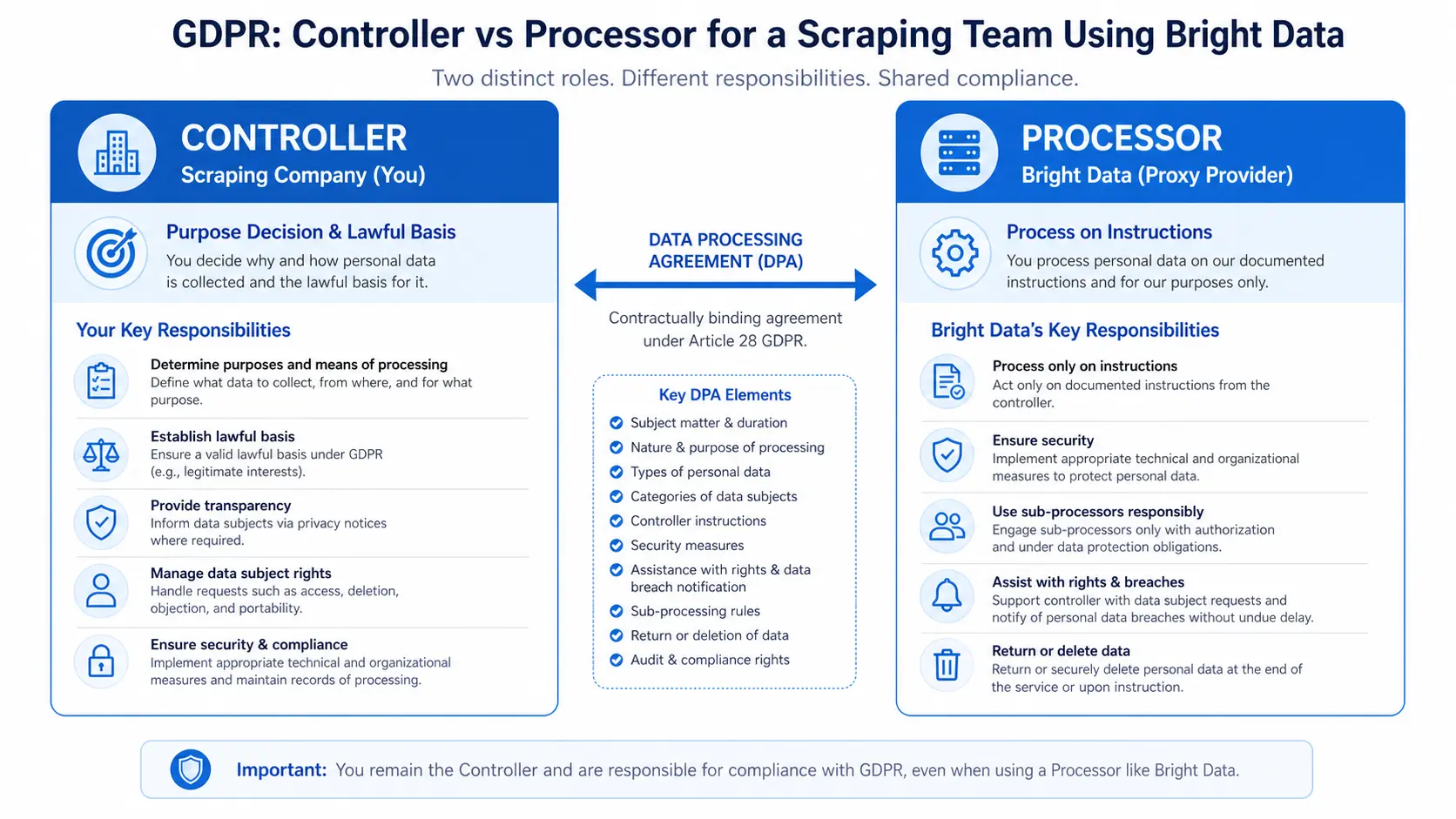
Under GDPR, Bright Data is generally a Processor and your company is the Controller. Controllers carry the burden of identifying the lawful basis, ensuring transparency, running DPIAs where risk is high, and handling data-subject rights. Bright Data provides the infrastructure-level controls — security, SOC2, the DPA itself.
APPI follows a similar split: Bright Data is a third-party processor and your company carries the supervision duty under Article 25. Treat contracts and audit evidence as work that legal owns, and align internally on that before any technical work begins.
Four GDPR Topics You Cannot Skip
If you touch personal data of EU residents, lock down these four areas first.
1. Identify the Lawful Basis
Article 6 of GDPR requires a documented lawful basis per processing purpose. For competitive price monitoring (public prices, no personal data), "Legitimate Interests" is workable. For job postings or any payload that could include names and emails, you must escalate to DPIA territory.
2. Data Minimization and Retention
Strip personal fields (names, emails, photos) from scraped payloads at ingest, before they reach long-term storage. Add an ETL layer right after Bright Data's Web Unlocker or Scraping Browser response. We pair this with cost-side levers documented in Bright Data Cost Optimization 2026 — the two designs share many of the same checkpoints.
3. Cross-Border Transfers
Moving personal data from the EU to Japan requires Standard Contractual Clauses (SCCs) or adequacy mechanisms. Japan holds an adequacy decision from the EU, so transfers are workable with supplementary measures. Map Bright Data's data center regions against your downstream warehouse locations (BigQuery, Snowflake) and document the chain end-to-end.
4. Data Subject Rights
If personal data ends up in your storage, you must field deletion, access, and correction requests. Bright Data is not the right contact point — the data lives in your systems. Build the deletion pipeline before launch, not after the first request arrives.
Extra APPI Considerations for Japan-Facing Teams
Japanese entities layering APPI on top of GDPR should also handle these items.
Supervision of Processors (Article 25)
You must confirm Bright Data's security controls, lock them into the contract, and review them periodically. Enterprise plans offer a DPA plus a custom addendum on request; route the ask through enterprise sales rather than the self-service portal.
Cross-Border Transfers (Article 28)
Bright Data operates primarily out of the US and Israel — neither has an APPI adequacy decision from Japan. You either (a) collect explicit subject consent for the transfer or (b) get Bright Data to document that it meets the standards set by Japan's Personal Information Protection Commission. In practice most teams choose the cleaner path:
- design so personal data never reaches Bright Data's network, or
- build a consent flow before any payload involving personal data is collected.
Locking down what you collect and what you drop at the design stage is the heart of APPI alignment.
Runtime Rules Engineers Should Enforce
Once legal has the paperwork, engineering enforces the runtime guardrails. Bot-defense edge cases overlap with these rules; see Bright Data CAPTCHA Handling Playbook 2026 for implementation patterns.
1. Honor robots.txt and Rate Limits
Bright Data can technically bypass many access controls, but compliance hinges on respecting robots.txt Crawl-Delay and target terms of service. Codify that the team will not touch disallowed paths or sites with explicit no-scrape language, and put the rule in your engineering playbook from day one.
2. Persist Audit Logs
Bright Data's console exposes per-zone request counts, success rates, and bandwidth. Export the metrics daily into BigQuery (or equivalent) and retain them for at least 12 months. That gives you a reproducible answer to "when did you hit which site, and how often?" — useful for both DPIAs and external audits.
3. Trigger Re-Review on ToS Changes
Target sites change their terms of service. Build a workflow that snapshots ToS and robots.txt every six months, diffs them, and escalates to legal on material changes. Without this, scraping pipelines silently drift out of compliance.
"KYC requirements and high minimum spends keep Bright Data out of indie pockets, but the same controls are what make legal teams comfortable."
KYC and minimum spend are actually compliance assets. They show that Bright Data verifies its customers, which auditors view as positive vendor governance. Frame that during legal reviews instead of treating it as a drawback.
How Smile Comfort Operates Bright Data
We run Tra-bell, a hotel price tracking service, on top of Bright Data's residential and Web Unlocker products. The architecture intentionally keeps personal data out of the pipeline, which has made compliance reviews lighter. Choosing the right proxy tier matters here too: we explain the trade-offs in Bright Data Residential vs ISP Proxy 2026: A Practical Selection Guide.
For external legal reviews we also help clients draft DPIA templates, data-flow diagrams, and DPA review notes for Bright Data engagements.
Wrap-Up
Bright Data is one of the more compliance-mature proxy vendors and can pass GDPR and APPI reviews when paired with thoughtful design. The vendor's investment does not erase your responsibilities, so plan around three layers — lawful basis with DPIAs, data minimization with cross-border mapping, and persistent audit logs — and you will keep production scraping workloads on the right side of legal review.
Even for public data collection, codify ToS and robots.txt adherence, snapshot them on a six-month cycle, and route changes through legal. That single workflow prevents the slow drift that turns compliant pipelines into liabilities.
Information current as of 2026-05-21. Please check the official sites for the latest updates.
This article contains affiliate links.
Frequently asked questions
Related articles
Bright Data Residential vs ISP Proxy 2026: A Practical Selection Guide
Bright Data Cost Optimization 2026: Cut Monthly Bills 30-70% With Proxy, Bandwidth, and Contract Tactics