Bright Data Pricing Cheat Sheet 2026: Product-by-Product Cost Guide
2026 cheat sheet for Bright Data pricing across Residential, Web Unlocker, SERP API and more, with PAYG vs commitment unit prices, monthly budget templates, and cost-optimization tips from our Tra-bell production experience.

This article contains affiliate links (advertising).
You opened the Bright Data pricing page, saw a dozen products, and could not tell which combination matches your workload. This article maps out Bright Data pricing as of May 2026, product by product and PAYG versus commitment, with unit-price cheat sheets for Residential, Web Unlocker, and SERP API, monthly budget templates, and a cost-optimization checklist, all grounded in our experience running Tra-bell on Bright Data1.
The Shape of Bright Data Pricing
Bright Data bills you on a product-by-product basis, where each product has its own unit (GB, request, IP, or month) and contract tier (PAYG, commitment, or enterprise). There is no single SaaS-style price card; instead, the dashboard simulator lets you plug in volume and geography to see numbers. The reason is structural: cost of goods scales differently by country, volume, and concurrency, so the unit price has to adapt2. A 1 GB workload routed through residential IPs in Japan looks nothing like a 1 GB workload through datacenter IPs in the US, and Bright Data prices them accordingly.
Four Billing Units
- Per GB: Residential, Datacenter, Mobile, Scraping Browser. Charged on bandwidth transferred, including request and response payloads.
- Per request: Web Unlocker, SERP API. Charged per 1,000 successful requests; failed requests are typically not billed.
- Per IP: ISP Proxy. Static residential IPs rented on a monthly basis, regardless of how much you use them.
- Per dataset row: Dataset Marketplace. Charged on prepared datasets such as Amazon products or LinkedIn profiles, billed per row of structured data delivered.
Different units mean different mental models. GB-based products reward bandwidth discipline; request-based products reward retry discipline; IP-based products reward concurrency planning. Mixing the wrong product with the wrong workload is one of the most common reasons a Bright Data bill comes in two or three times over expectation.
Three Contract Tiers
- PAYG (Pay-as-you-go): credit-card billing, no minimum. Best for trials and small PoCs.
- Commitment contract: monthly or annual minimum spend, with unit prices 20 to 40% lower.
- Enterprise: dedicated AE, 99.99% SLA, custom features. Annual contract assumed.
The realistic path is to start on PAYG, capture three to six months of usage data, and then negotiate a commitment plan with that evidence in hand. Skipping straight to a commitment contract before you understand your real bandwidth and request mix usually overshoots; teams end up paying for capacity they do not use. We have seen the opposite failure too - sticking with PAYG long after a steady 50 GB/month pattern emerged, leaving 20 to 30% in unit-price savings on the table.
2026 Pricing Trends
X chatter shows that AI training data demand is pushing Bright Data usage up, but no large-scale official price increase has been announced. The recurring complaint, however, is that "scale runs the bill up fast," and in our experience the monthly invoice can differ by a factor of 5 to 10 depending on how the pipeline is designed. The same 1,000-SKU price monitoring workload can land at $80/month or $800/month depending on whether the team uses diff monitoring and asset blocking from day one.
Some users explore alternatives, but once they measure detection and success rates side by side, many return to Bright Data. Comparing on unit price alone tends to mislead the decision because the metric that matters for a scraping pipeline is dollars per successfully delivered record, not dollars per GB transferred. A 30% lower unit price that comes with a 20-point lower success rate is rarely a real saving.
Unit Price Cheat Sheets (May 2026)
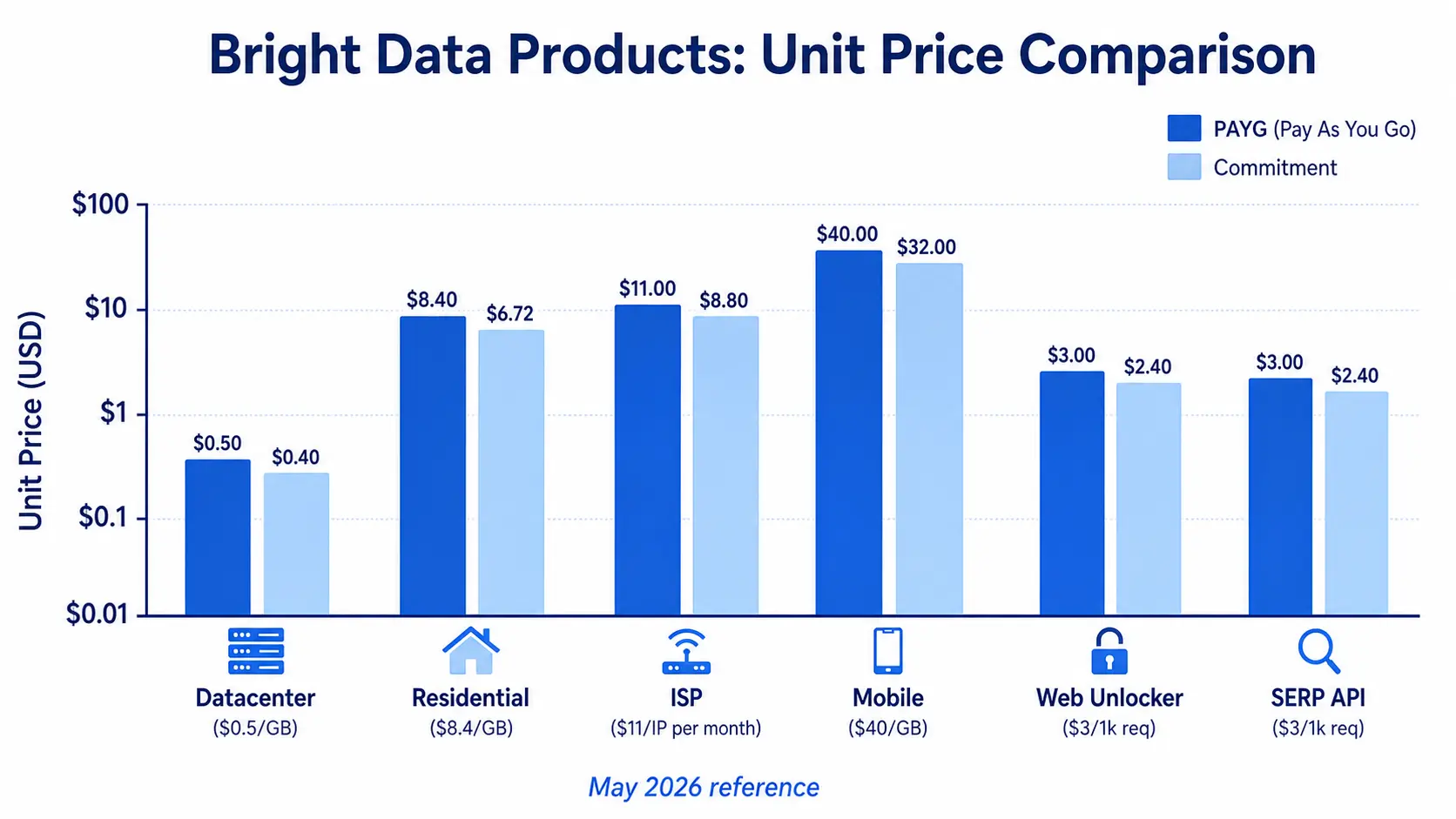
The eight main products, summarized by PAYG unit price, indicative commitment-tier price, and primary use case. FX is shown for reference at 1 USD ~= 158 JPY (May 2026).
Residential / Datacenter / ISP / Mobile
| Product | PAYG unit price | Commitment range | Primary use |
|---|---|---|---|
| Residential Proxy | from $8.4/GB (~¥1,330/GB) | $4 to $6/GB | Large e-commerce, SNS, SaaS scraping |
| Datacenter Proxy | from $0.5/GB (~¥80/GB) | $0.3 to $0.4/GB | General info sites, internal tools |
| ISP Proxy | from $11/IP per month (~¥1,740/IP per month) | $7 to $9/IP per month | Stable account operation |
| Mobile Proxy | from $40/GB (~¥6,320/GB) | $25 to $30/GB | App-only marketplaces, SNS bot bypass |
Web Unlocker / SERP API / Scraping Browser
| Product | PAYG unit price | Commitment range | Primary use |
|---|---|---|---|
| Web Unlocker | from $3/1k req (~¥474/1k req) | $1.5 to $2/1k req | Auto-bypass for CAPTCHA, Cloudflare, Akamai |
| SERP API | from $3/1k req (~¥474/1k req) | $1.5 to $2/1k req | Structured JSON for Google or Bing search |
| Scraping Browser | from $9/GB (~¥1,420/GB) | $5 to $7/GB | Playwright/Puppeteer compatible, stealth built in |
| Dataset Marketplace | Per row or dataset | Custom quote | Amazon products, LinkedIn, and other prepared data |
Bright Data adjusts pricing roughly once a quarter, with the latest unit prices on each product LP3. Numbers here are reference values as of the publication date; always verify in the official dashboard immediately before signing.
Per-Record Cost at High Volume
Reported and observed numbers at scale put Bright Data around "$0.001 per record" (roughly one-tenth of a US cent) for high-volume use. That number assumes a well-tuned pipeline with asset blocking, diff monitoring, and a long-running session strategy; without those, the same workload can land at four to six times the per-record cost.
The pricing is intentionally designed so unit cost falls as volume rises. That makes "do we have enough volume to justify a commitment plan?" the single biggest lever in Bright Data cost optimization. The threshold is not a fixed number, but in practice we have found that steady 50 to 100 GB/month of Residential traffic, or roughly 200,000 Web Unlocker requests/month, are the points where a commitment quote starts to undercut PAYG meaningfully. For an end-to-end implementation pattern, see our deep dive on building a price monitoring pipeline on Bright Data Residential.
Monthly Budget Templates
Typical product mixes and use cases at each budget tier. Use these as a starting point when explaining "what we can do with Bright Data at $X/month" to a decision maker.
$20 to $100/month: PoC and Light Scraping
- Mix: Residential Proxy only (1 to 10 GB), with a small slice of Datacenter for high-volume but loss-tolerant targets.
- Use cases: 100-SKU price monitoring, periodic SNS profile checks, SERP monitoring on specific keywords.
- Watch out: Residential unit price dominates the bill, so blocking images, CSS, and analytics tags is mandatory.
At this tier, the goal is not to be cost-efficient yet - it is to measure. Burn a few GB of Residential to learn which targets respond well to Datacenter, which need plain Residential, and which require Web Unlocker. That measurement guides every architectural decision in the next tier.
$200 to $500/month: Mid-Scale Production
- Mix: 10 to 50 GB Residential plus Web Unlocker (for high-value SKUs only) and a light DWH such as BigQuery or RDS.
- Use cases: 1,000 to 10,000 SKU daily price monitoring, multi-marketplace coverage, competitive SEO tracking.
- Watch out: Introducing diff monitoring here cuts the bill by half to two-thirds. It is the single biggest fork in the road.
This tier is where most growth-stage companies live, and where Bright Data bills become predictable enough to justify a commitment quote. Operators who stay on PAYG at this scale often pay 30 to 40% more than they need to, simply because nobody has asked for a custom quote yet.
$1,000 to $5,000/month: Production with Multiple Systems
- Mix: 100 to 500 GB Residential plus Web Unlocker, SERP API, and Scraping Browser, with a dedicated DWH such as Snowflake.
- Use cases: Nationwide e-commerce monitoring, AI training data pipelines, multi-team SaaS data layers.
- Watch out: A commitment contract is mandatory. If there is no dedicated Bright Data operator on staff, an external partner shortens ramp-up significantly.
At this tier the conversation shifts from "what does Bright Data cost?" to "how do we route traffic between products to keep the total below our target?" Most invoices we have seen at this scale are between 40 and 60% Residential, 20 and 30% Web Unlocker, with the rest distributed across SERP API and Scraping Browser.
A common failure pattern is "the $200/month PoC turned into a $5,000/month bill the moment we 10x'd the SKU count." If the architecture is not revisited at each scale step, invoices commonly land at 10 to 20x of the original estimate. The mitigation is mechanical: run a quarterly cost review that breaks invoices down by product and target site, and reallocate before the next billing cycle.
Cost Optimization Checklist: Cut the Bill to One-Third
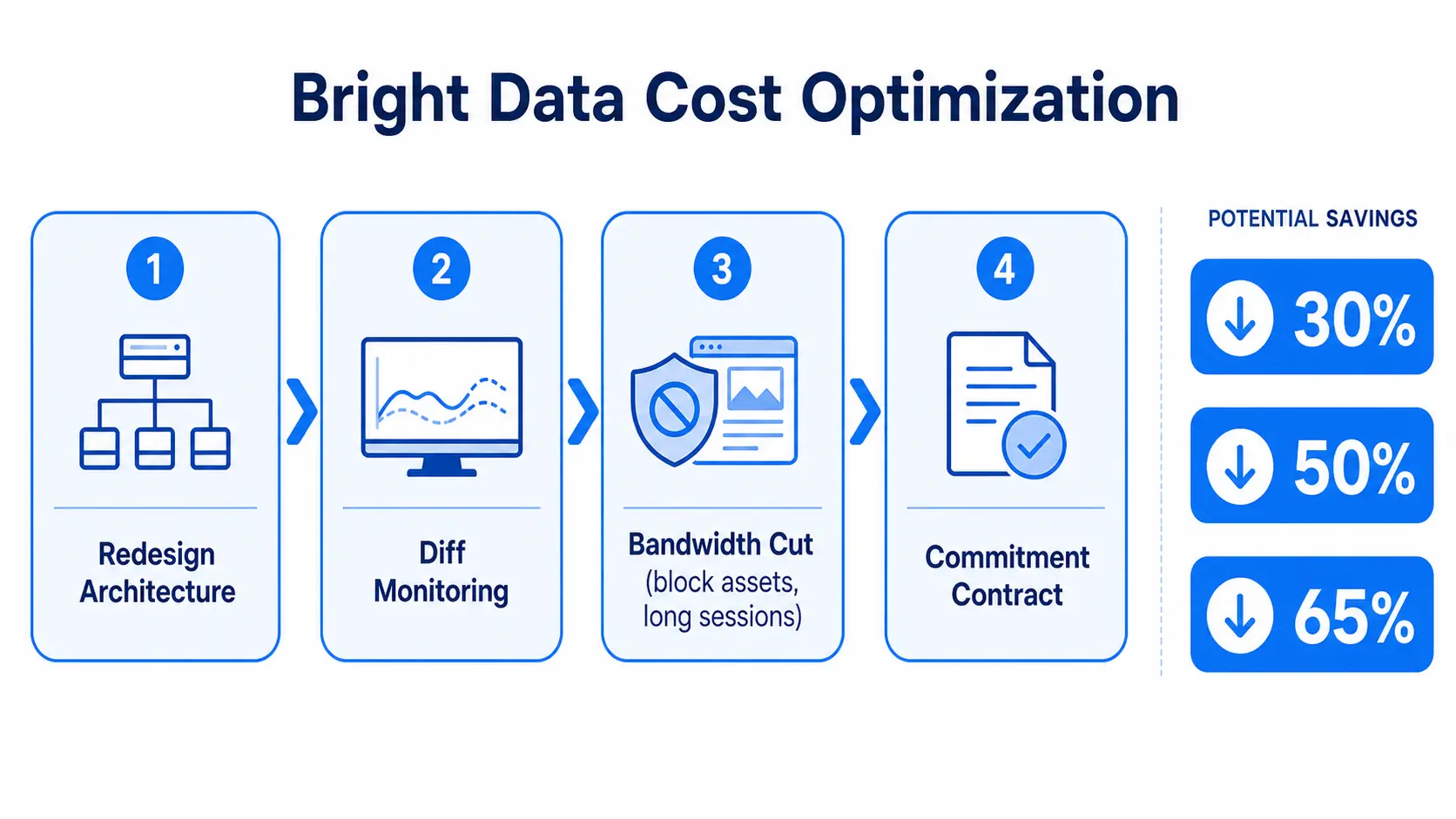
The lever to lower the unit price of Bright Data itself is limited, but architectural choices can cut the invoice by 30 to 70%. The following seven actions had the largest impact in the early days of running Tra-bell.
Seven High-Leverage Actions
- Block static assets: skip images, CSS, and analytics tags. Bandwidth drops 50 to 70%.
- Switch to diff monitoring: re-fetch only SKUs whose price or stock changed; request count drops by two-thirds.
- Long sessions: reuse the same IP for 30 minutes to a few hours to amortize handshake overhead.
- Limit Web Unlocker to high-value SKUs: regular SKUs go through plain Residential; only Cloudflare-protected pages use Web Unlocker.
- Tune geo and ISP filters: limit to the countries and ISPs you actually need to cut wasted routing.
- Codify retry strategy: never use blind 3x retries; branch by error class.
- Make volume visible, then commit: with three to six months of PAYG data, negotiate a commitment contract.
The concrete implementation pattern for price monitoring is covered in our deep dive on Bright Data Residential with architecture diagrams and Python code. Combining diff monitoring with long sessions alone can compress a $500/month workload down to $150 to $200, a realistic and repeatable outcome.
How to Decide Between Bright Data and Alternatives
On unit price alone, Smartproxy, Decodo, and SOAX can look cheaper. Factor in detection resistance, success rate, and support quality, however, and Bright Data often comes out on top on total cost of ownership.
Four Decision Axes
- Bot defense strength of the target: hardened e-commerce or SNS sites favor Bright Data; lightly defended info sites can go to alternatives.
- Required success rate: 99%+ pushes you to Bright Data; 95% leaves room for cheaper vendors.
- Monthly volume: at 100 GB+ Bright Data commitment plans are competitive; below a few GB, smaller vendors may win.
- Legal requirements: workloads bound by GDPR, CCPA, or APPI benefit from Bright Data's KYC-verified IPs.
A useful exercise before signing any contract is to score your top three to five target sites on each of these axes. If three of the four point to Bright Data, the unit-price gap with cheaper vendors typically closes once you weight by failure rate. If two or fewer axes point to Bright Data, a hybrid (cheaper vendor for the easy targets, Bright Data for the hard ones) is often the best total-cost answer.
We run Tra-bell, a hotel price tracking product, on Bright Data Residential and Web Unlocker, and can advise on the PAYG-to-commitment transition, product mix tuning, and architectural cost optimization grounded in production experience.
Wrap-Up
Bright Data pricing is the product of "product times contract tier." PAYG starts from a few tens of dollars per month, and production workloads typically land between several hundred and several thousand dollars. The biggest driver of the actual bill, though, is not the contract tier - it is architectural choices like diff monitoring, asset blocking, and long sessions, which can cut costs by 30 to 70%. When comparing against other vendors, do not stop at unit price; weigh detection resistance, success rate, and legal posture together, and translate the comparison into dollars per successfully delivered record rather than dollars per GB. If you need data to make the call internally, the fastest path is to spin up a free account, run two weeks of small-scale traffic against your real target sites, and bring the success-rate numbers into the procurement conversation.
Information current as of 2026-05-21. Please check the official sites for the latest updates.
This article contains affiliate links.
Footnotes
-
Bright Data Official Pricing https://brightdata.com/pricing ↩
-
Bright Data Proxy Networks https://brightdata.com/proxy-types ↩
-
Bright Data Documentation https://docs.brightdata.com/ ↩
Frequently asked questions
Related articles
Bright Data Residential Proxy for Price Monitoring: A How-To

n8n x Bright Data 2026: No-Code Automated Data Collection Guide