Bright Data vs Oxylabs 2026: Pricing, Features, and Success Rates Compared
Compare Bright Data and Oxylabs with 2026 data: pricing, residential proxy quality, Scraper API DX, and support reviews. Use-case-based guidance and real production insights from Smile Comfort included.
This article contains affiliate links (advertising).
"Should we go with Bright Data or Oxylabs?" is one of the most common questions we hear from teams building a scraping stack. This guide compares both vendors as of May 2026 across pricing, residential proxy quality, Scraper API developer experience, and support reputation - with use-case-based recommendations grounded in our own Bright Data production runtime and our Oxylabs evaluation work1.
Where Bright Data and Oxylabs Sit Today
Both vendors sit at the top tier of the proxy and web-scraping market, well above budget options like Smartproxy or Decodo. They lead with ethically sourced IPs and enterprise-grade SLAs that hold up under sustained, large-scale workloads2.
Bright Data's Position
Bright Data (formerly Luminati) was founded in 2014 and is now US-headquartered, with one of the industry's longest histories. Its calling cards are a roughly 150-million-IP residential pool - among the largest available - and a broad lineup spanning Web Unlocker, Scraping Browser, and a Dataset Marketplace. Enterprise teams tend to choose Bright Data when they need scale plus granular control.
Oxylabs's Position
Lithuania-based Oxylabs grew quickly by polishing its Scraper API suite (Web Scraper API, SERP API, E-commerce API) into a developer-friendly experience. It tends to win mind share with teams that want to minimize coding effort and avoid building their own JavaScript rendering or anti-bot logic.
Shared Strengths
- Ethically sourced residential IPs: both publish KYC-based sourcing flows rather than peer-network shortcuts
- Enterprise SLAs: 99.9%+ uptime, 24/7 support
- Comprehensive lineup: Residential, ISP, Datacenter, Mobile, plus Scraper APIs
- Compliance posture: GDPR, CCPA, and other privacy regimes covered with documented internal controls
X discussions routinely place Bright Data and Oxylabs side by side as the two go-to high-quality residential providers, especially for teams targeting tightly defended large e-commerce or social platforms.
Pricing Breakdown
Standalone unit pricing lands in a similar band for both vendors, but contract structures, minimums, and committed-use discounts differ in subtle ways. For a deeper Bright Data pricing teardown, see Bright Data Pricing Cheat Sheet 2026.
Residential Proxy Unit Pricing
| Item | Bright Data | Oxylabs |
|---|---|---|
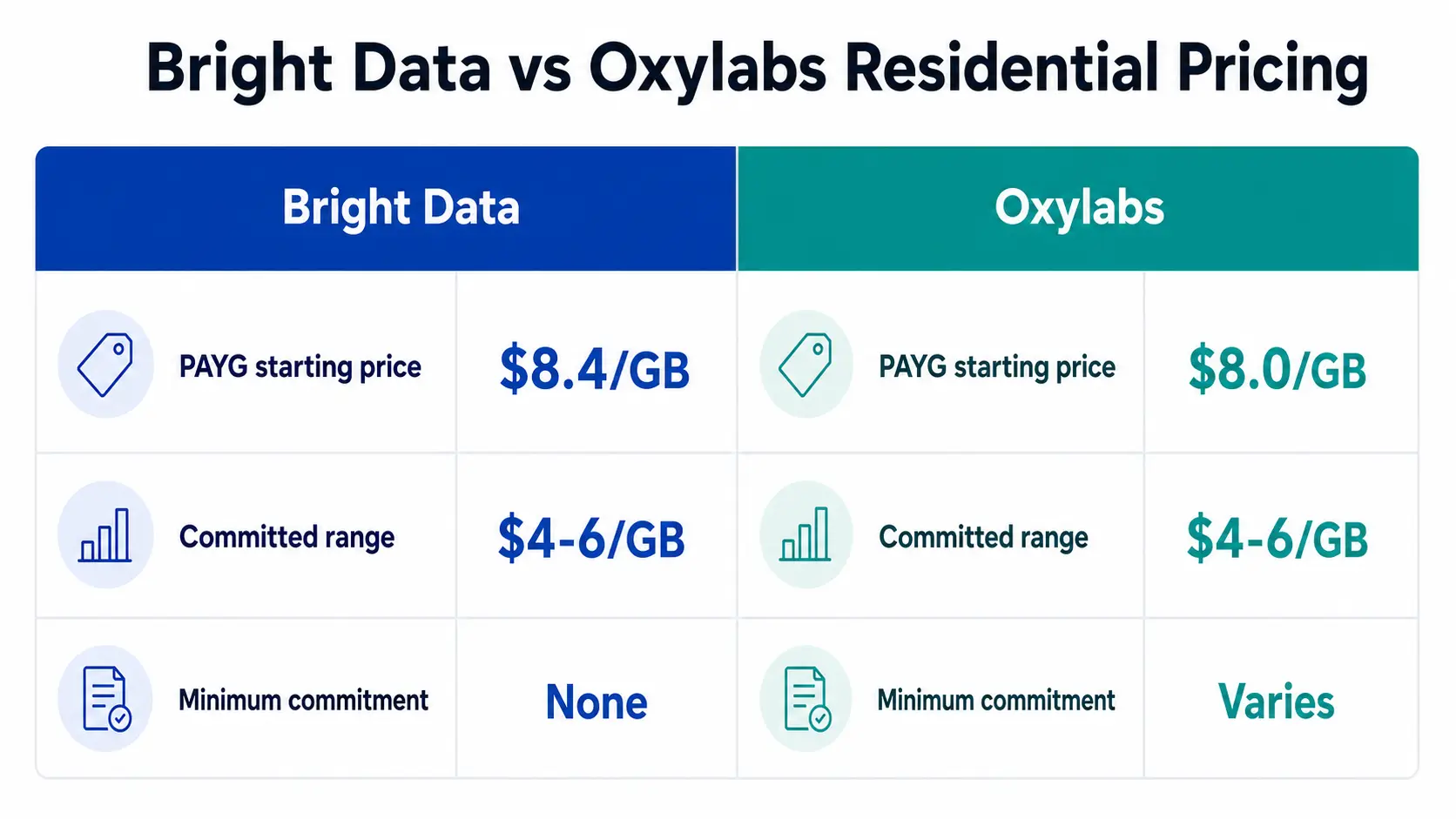
| PAYG starting price | $8.4/GB (~¥1,330/GB) | $8.0/GB (~¥1,260/GB) |
| Committed range | $4-6/GB | $4-6/GB |
| Minimum commitment | None (PAYG available) | Varies (e.g., $99/mo plans) |
| FX assumption | 1 USD ≈ ¥158 (May 2026) | 1 USD ≈ ¥158 (May 2026) |
Oxylabs edges Bright Data slightly on PAYG starting price, and Bright Data's cost is a regular topic of complaint on X3.
In practice, the ranking often flips once you hit roughly 50 GB/month and trigger committed-use discounts, so unit price alone is a poor decision driver.
Scraper API / Web Unlocker Pricing
| Item | Bright Data | Oxylabs |
|---|---|---|
| Web Unlocker / Web Scraper API | $3/1k req (~¥474/1k req) | $2-4/1k req |
| SERP API | $3/1k req (~¥474/1k req) | $2.6/1k req |
| E-commerce API | (Covered via Web Scraper or Datasets) | $2/1k req |
Oxylabs offers a richer roster of domain-specific APIs, which can shrink integration effort for teams that hit one major site (Amazon, Rakuten, eBay) on a recurring schedule.
A Pricing Checklist That Avoids Surprises
- Measure actual GB and request counts on PAYG before locking in a commitment
- Test against multiple target sites - single-site benchmarks skew the math
- Request committed-use pricing once you cross ~50 GB/month
- Confirm the failed-request billing policy upfront - vendors handle it differently
- Account for FX risk - both vendors bill in USD by default
Product Lineup Differences
Each vendor leans heavily into different parts of the stack. Miss this picture and you might pick "Bright Data Scraper" or "Oxylabs Web Unlocker" thinking they're peers - they're not the same products.
Where Bright Data Pulls Ahead
- Web Unlocker: API that defeats CAPTCHA, Cloudflare, and Akamai-style bot defenses, with very fast update cycles
- Scraping Browser: Puppeteer/Playwright-compatible with stealth baked in - excellent for complex SPAs
- Dataset Marketplace: Buy ready-to-use datasets (Amazon listings, LinkedIn profiles, and more)
- Proxy Manager: Self-hosted control plane for routing, caching, and retries without writing code
- IP scale and geo coverage: ~150 million IPs, 195 countries, with city-level targeting
Where Oxylabs Pulls Ahead
- Web Scraper API: One call returns parsed JSON with JS rendering and anti-bot handling
- SERP API: Structured JSON for Google, Bing, and other engines - no headless browser required
- E-commerce API: Purpose-built for Amazon, eBay, and similar marketplaces, including parsed product and review data
- Real Estate API: Emerging product line for Zillow, Realtor.com, and other property portals
- OxyCopilot: AI-assisted Scraper configuration - a growing differentiator
How to Pick Lineups
- "I just want clean data with almost no code": Oxylabs Web Scraper API / SERP API
- "I need infrastructure I can shape at scale": Bright Data proxies + Web Unlocker
- "We pull from one major e-commerce site repeatedly": Oxylabs E-commerce API or Bright Data Dataset Marketplace
- "We want to buy pre-built datasets": Bright Data Dataset Marketplace, hands down
Success Rate, Performance, and Support
What really moves the cost needle is total cost = unit price + retry overhead + ops time, not the headline GB price. This is where a "cheap" choice often turns expensive.
Real Success Rates
From public benchmarks and our own measurements, the picture looks like this.
- Large e-commerce (Amazon, Rakuten, eBay): both vendors land in the 95-98% band, with 1-2% site-by-site swings that retry budgets absorb
- Social platforms (X, Instagram, TikTok): Bright Data Web Unlocker is a step ahead, with Oxylabs Web Scraper API closing the gap
- Google SERP: Oxylabs SERP API delivers very consistent structured output; Bright Data SERP API performs comparably
No headline result replaces a 1-2 day trial on your actual targets. For a worked example of building a price-monitoring pipeline on residential proxies, see Bright Data Residential Proxy for Price Monitoring.
Support and User Sentiment
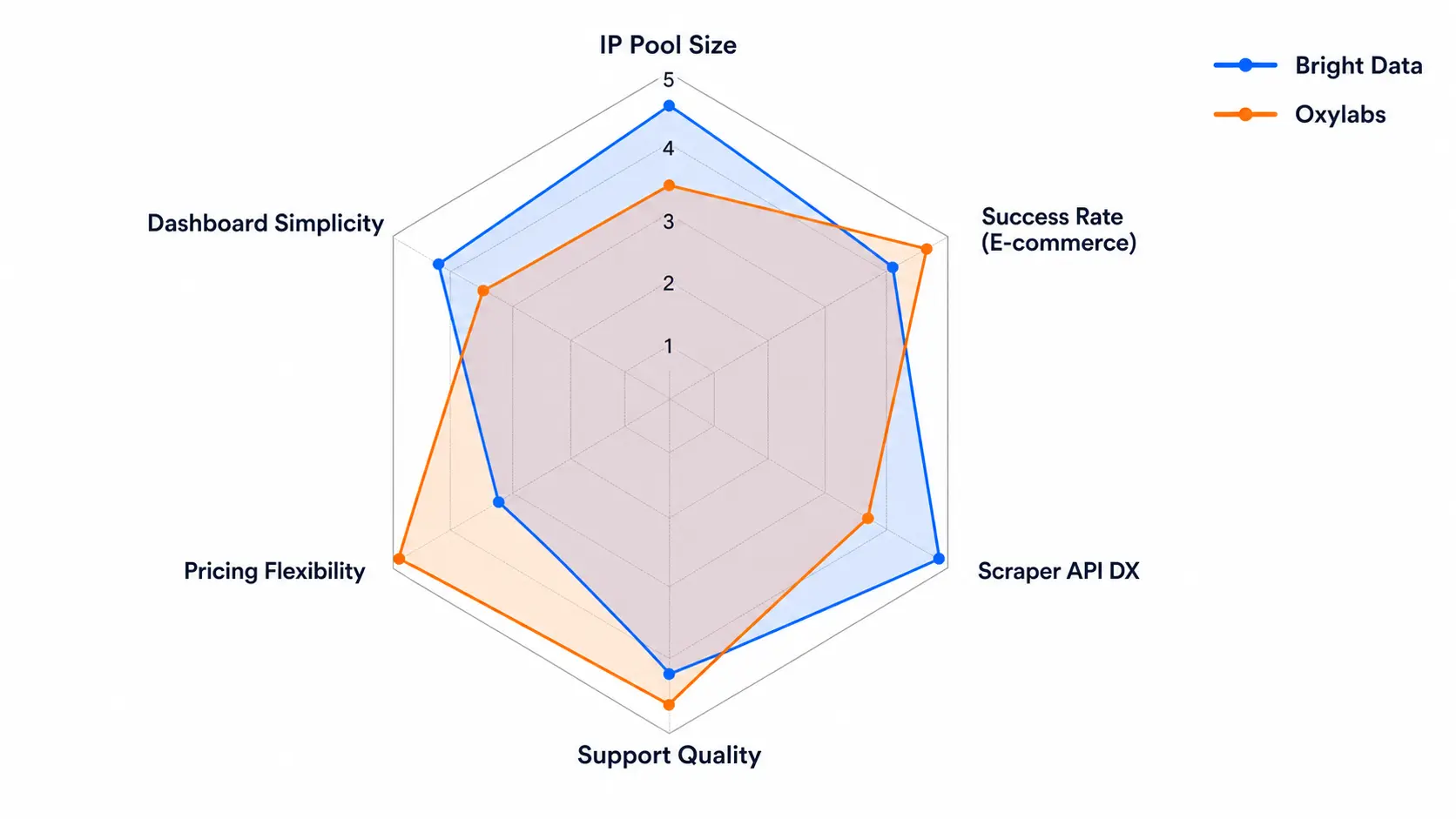
HackerNoon's April 2026 analysis of 1,600+ Trustpilot reviews scored Bright Data at 4.5/5 and Oxylabs at 3.7/5.
Bright Data tends to win on billing transparency, support responsiveness, and overall reliability, while Oxylabs retains a loyal base for API usability. Reviews carry sampling bias, so the safest read is to open a couple of test tickets with both vendors and judge for yourself.
Developer Experience
- Documentation: both are thorough and English-first, with rich code samples; Bright Data offers slightly richer Japanese-language UI
- Dashboards: Bright Data is feature-dense with a steeper learning curve; Oxylabs is simpler
- SDKs and samples: Python, Node.js, and cURL examples available from both, ready to download
- Community: Bright Data has a head start on Slack/Discord-style community presence
Picking a Winner by Use Case
Four common production scenarios and which way we'd lean.
Case 1: Mid-size E-commerce Price Monitoring (30-100 GB/month)
- Pick: Bright Data Residential + Web Unlocker
- Strong detection bypass on major e-commerce, with Proxy Manager controls
- Committed-use pricing closes most of the price gap with Oxylabs
- Adding Web Unlocker on top of existing scrapers needs minimal code change
Case 2: SERP / Search Monitoring (100-500 million requests/month)
- Pick: Oxylabs SERP API
- Structured JSON output is stable and saves engineering hours
- Bright Data SERP API is a viable alternative, but Oxylabs tends to "just work" faster out of the gate
Case 3: Large-scale Scraping Platform (TB-scale, multi-site, long-running)
- Pick: Bright Data as core, Oxylabs as partial complement
- IP pool, SLA, and compliance audit posture meet enterprise requirements
- Route a few stubborn sites to Oxylabs Scraper API only if success rates lag
Case 4: Buying Pre-built Datasets (Amazon listings, LinkedIn profiles, etc.)
- Pick: Bright Data Dataset Marketplace, no contest
- Oxylabs has a thin pre-packaged dataset catalog
- Lower legal risk than self-scraping, since Bright Data handles licensing
Optimize the Mix, Not the Winner
After running both, our take is that "Bright Data vs Oxylabs" is less a binary choice than a portfolio decision: which one is your core, and where do you supplement with the other. Always run a use-case-specific simulation before signing.
How Smile Comfort Can Help
We have run Bright Data in production for over two years and have evaluated Oxylabs across multiple client engagements. We have learned (sometimes the hard way) which choices look cheap on paper but blow up under real success-rate constraints - and which hybrid setups actually save money.
A sample of what we can help with:
- Proxy Zone design by use case (price monitoring, SERP monitoring, social analytics, etc.)
- Bright Data vs Oxylabs comparison trial design and success-rate measurement
- Cost optimization across Residential, Datacenter, and Web Unlocker mixes
- Scraping infrastructure on AWS or GCP (Lambda / Cloud Run + Bright Data + S3 + Snowflake)
- Data platform integration (BigQuery, Snowflake, dbt pipelines)
- Compliance hygiene (robots.txt adherence, rate control, terms-of-service review)
We run Tra-bell, our in-house hotel price-tracking service, on Bright Data's Residential and Web Unlocker stack. Because we have also evaluated Oxylabs as a comparison vendor, we can advise from the PoC design stage onward.
Summary
Bright Data and Oxylabs are two top-tier vendors at a similar price point, but they emphasize different strengths: Bright Data leans into scale and control, Oxylabs into developer experience and APIs. Unit pricing is close to parity, Bright Data leads on IP pool and management tooling, and Oxylabs leads on Scraper API breadth. The right answer depends on your monthly volume and target sites, which makes a real trial mandatory before committing. Hybrid setups are common in production, so you do not need to commit to one vendor on day one.
Information current as of 2026-05-21. Please check the official sites for the latest updates.
This article contains affiliate links.
Footnotes
-
Bright Data official site - https://brightdata.com/ ↩
-
Oxylabs official site - https://oxylabs.io/ ↩
-
HackerNoon's April 2026 Trustpilot review analysis - https://x.com/hackernoon/status/2045139730472350044 ↩
Frequently asked questions
Related articles
Bright Data Pricing Cheat Sheet 2026: Product-by-Product Cost Guide
Bright Data Residential Proxy for Price Monitoring: A How-To