Bright Data Mobile Proxy Guide 2026: 4G/5G CGNAT IPs and Social Media Use Cases
When Bright Data's Mobile Proxy (4G/5G CGNAT) is worth its price, how it differs from Residential/ISP/Datacenter, and how it compares to MoMoProxy and Byteful.
This article contains affiliate links (advertising).
Should you actually pick Bright Data's Mobile Proxy? The straight answer is yes when your workload hits a mobile-only wall that Residential or ISP cannot climb — otherwise other proxy types (or other providers) win on cost. This guide breaks down how 4G/5G CGNAT IPs work, how Mobile differs structurally from Residential, ISP, and Datacenter, where it genuinely earns its price in social media operations and ad verification, and how Bright Data Mobile compares against 2026's newer challengers like MoMoProxy and Byteful1.
What Bright Data Mobile Proxy Actually Is
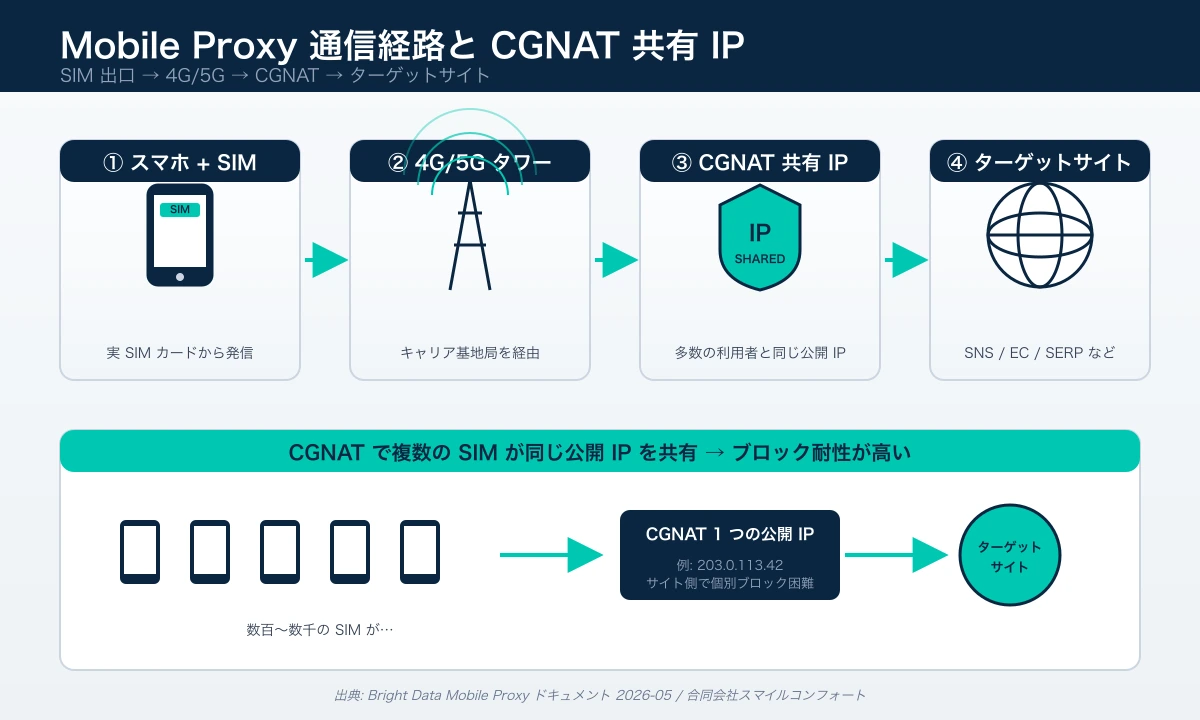
Bright Data's Mobile Proxy uses 4G/5G connections from real SIM cards in physical smartphones as the exit point. Residential proxies borrow fixed home Wi-Fi connections; Mobile borrows a carrier's mobile network. That starting point drives everything downstream.
SIMs Out, CGNAT in the Middle
Exit IPs come from mobile carriers — AT&T and Verizon in the US, NTT Docomo and SoftBank in Japan, and equivalents in 190+ countries. Most carriers deploy CGNAT (Carrier-Grade NAT), so a single public IPv4 address routes traffic for hundreds or thousands of phone users at once. Target sites cannot distinguish a "real" mobile user from an automated one by IP alone, since both flow through the same shared address.
The practical effect is that anti-bot systems lose their cheapest signal. Datacenter ASN ranges are flagged by default at many large sites. Residential ASNs avoid that, but each IP typically maps to one household with predictable behavior. Mobile traffic adds a third layer: the IP itself is shared with active, legitimate mobile users every minute of every day. Cutting it off has real collateral damage, which moves the cost-benefit calculation against blocking.
IP Pool and Geo Targeting
Bright Data publishes a mobile IP pool of 7 million-plus across 195+ countries, with city- and carrier-level targeting (for example, "Tokyo on NTT Docomo only")2. Zone configuration follows the same flow as other Bright Data products — if Zone setup is new to you, see the Bright Data Proxy Zone Design and Setup 2026 guide first.
Official Pricing
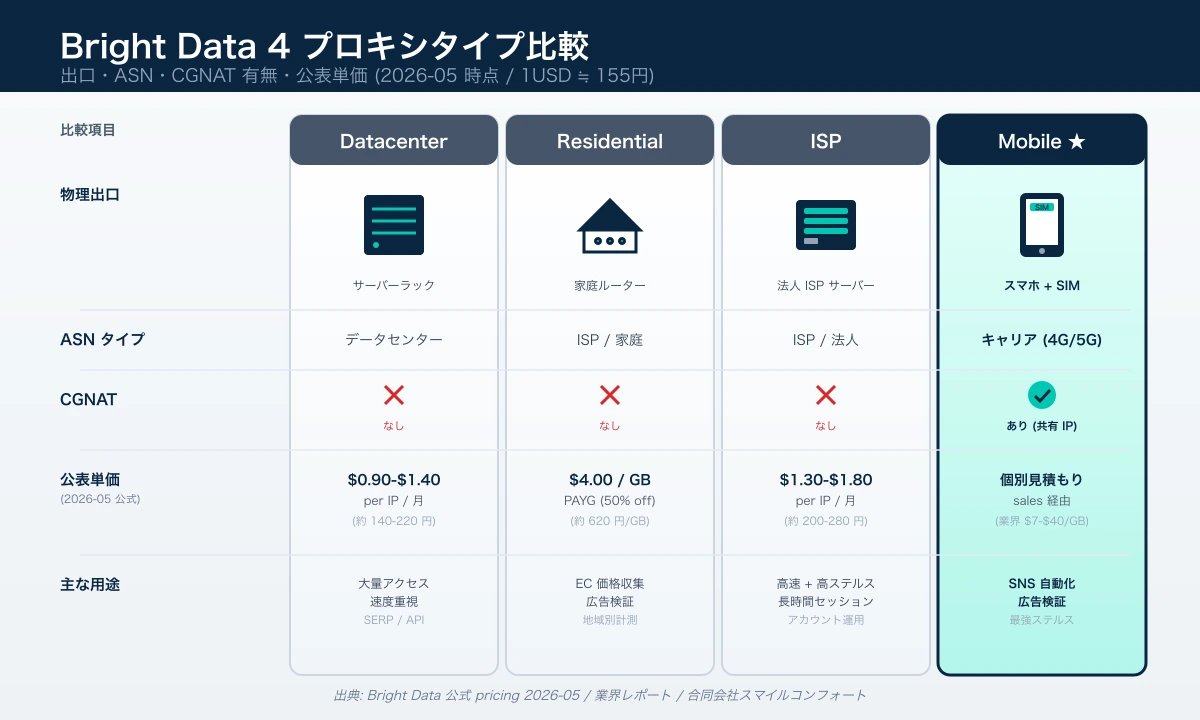
As of May 2026, Bright Data's public Proxy Network pricing hub3 does not list a standalone tier for Mobile — Mobile is sold via custom sales quotes (industry references position the per-GB band at roughly $7 to $40 / ~¥1,100 to ~¥6,200; FX assumed at 1 USD ≒ ¥1554). The same hub publishes the other three product lines as follows:
- Residential: $4.00/GB PAYG (~¥620/GB) after the official 50% promo. List is $8.00/GB (~¥1,240/GB); volume commits drop to $2.50–$3.50/GB (~¥390–¥540/GB).
- ISP: $1.30–$1.80/IP/month (~¥200–¥280/IP/month), tiered by IP volume (10–1,000 IPs).
- Datacenter: $0.90–$1.40/IP/month (~¥140–¥220/IP/month), billed per IP, not per GB.
Mobile and Residential are per-GB; ISP and Datacenter are per-IP/month. That unit mismatch is the first thing to recognize before "GB price" comparisons across the four lines. The cross-product comparison is in our Bright Data Pricing Cheat Sheet 2026.
How Mobile Differs from Residential, ISP, and Datacenter
The hardest choice is among four similar-sounding products that span two orders of magnitude in price. The structural differences are what matters.
Different Physical Exits
- Datacenter Proxy: Exits at a datacenter server. Fastest, cheapest, but the ASN is a datacenter — easiest to detect.
- Residential Proxy: Exits at a real consumer's fixed line (Wi-Fi). ASN is a residential ISP.
- ISP Proxy: Datacenter server hosting IPs allocated by a residential ISP. ASN is residential, throughput is datacenter-grade.
- Mobile Proxy: Exit is a real smartphone SIM. ASN is a mobile carrier (Verizon, NTT Docomo, etc.), and traffic sits under CGNAT.
If you need a Residential vs ISP breakdown before deciding among all four, the Bright Data Residential vs ISP Proxy 2026 selection guide covers it in detail.
Comparison Across the Selection Axes
The matrix below combines our operational experience with Bright Data's official product comparison.
| Axis | Datacenter | Residential | ISP | Mobile |
|---|---|---|---|---|
| Stealth (block resistance) | Low | High | Medium–High | Highest tier |
| Speed / throughput | Highest | Medium | High | Medium (carrier-bound) |
| Billing unit | per IP / month | per GB | per IP / month | per GB |
| Price (per-GB or per-IP) | $0.90–$1.40/IP/month (~¥140–¥220) | $4.00/GB PAYG (~¥620/GB); $8.00/GB list | $1.30–$1.80/IP/month (~¥200–¥280) | Custom sales quote (no public tier) — industry ref. $7–$40/GB |
| Geo targeting granularity | Country | City / ASN | City | Country / Carrier / City |
| Best fit | Bulk, low cost | General web scraping | Stable sessions | Social media, mobile ads, mobile-only UA |
| CGNAT structure | None | None | None | Yes (100s–1000s share one IP) |
Mobile's edge is not "faster and cheaper" — it is the structural fact that you share an IP with real consumers, which raises the cost of blocking for the target site.
Where Mobile Earns Its Price — Social, Ads, Mobile SERPs
Mobile Proxy justifies its per-GB cost only when you need data that simply cannot be obtained over non-mobile networks.
Instagram, TikTok, and X Account Operations and Scraping
Instagram, TikTok, and X all treat traffic from mobile apps as the default and treat desktop-originated automation as suspect. The same user account hitting public endpoints repeatedly from Datacenter or even Residential IPs commonly triggers temporary suspension or rate-limited responses. Mobile Proxy traffic, by contrast, mixes in with real consumer traffic under CGNAT, extending operational runway.
The community is openly comparing mobile providers for X / Twitter use cases:
For context, MoMoProxy's tweet below positions itself for X/Twitter operations specifically. Many teams use it as a low-cost alternative or fallback to Bright Data's premium Mobile tier.
Bright Data Mobile is more expensive per GB than MoMoProxy, but its SLA and audit posture make it easier to put on the critical production path. A two-lane setup — challengers for trials, Bright Data for audited production — is a real pattern we see.
Mobile Ad Verification
Publishers and ad networks routinely serve different creatives to mobile vs. desktop, and to specific carriers. If you need to verify "what does this ad slot actually show on a 5G connection on NTT Docomo," Mobile Proxy with carrier-level targeting is the only realistic path. Brand-safety teams and competitive-intelligence teams that monitor mobile ad placements across markets typically combine Bright Data Mobile with a screenshot pipeline (Scraping Browser plus Playwright) to log creative variations day over day.
Mobile SERP Capture
Search engines (Google, Bing, Yahoo!) render different SERPs for mobile UA + mobile origin. For SEO rank tracking that needs mobile accuracy, Mobile proxies in front of the SERP API matter. Local pack results, app store promotions, and AMP-style cards are especially sensitive to the request's network origin, and a Datacenter-routed mobile UA still does not reproduce a real mobile network's view. We cover the automation flow itself in Automating SEO Rank Tracking With Bright Data: A 2026 Implementation Guide for Daily SERP Rankings.
2026 Competitive Landscape — MoMoProxy and Byteful Rise
In 2026, several newer providers have entered the 4G/5G CGNAT space at meaningfully lower price points.
Byteful — Launched May 2026
Byteful announced its Mobile Proxy line in May 2026 with the following highlights5:
- 6 million+ mobile IPs
- 650+ carriers across 190+ countries
- Real 4G/5G IPs behind CGNAT
- Sub-600ms response speeds
- Non-expiring data (unused bandwidth does not lapse)
- Pricing from roughly $2.25/GB (~¥350/GB)4
The launch post:
MoMoProxy — Gaining Traction in X / Twitter Workflows
MoMoProxy markets itself with high success rates for X / Twitter automation at roughly $3/GB (~¥470/GB)4. It increasingly shows up as a Bright Data alternative for social-media-heavy workloads.
Where Bright Data Mobile Still Wins
Newer providers compete on price, but Bright Data Mobile holds clear advantages where production maturity matters:
- Compliance: KYC-verified IP sourcing aligned with GDPR and APPI (Japan)
- SLA: 99.99% uptime guarantee, 24/7 support
- Unified product line: Residential, ISP, Datacenter, Mobile, Web Unlocker, and SERP API in one dashboard, so adding Mobile to an existing Bright Data footprint is a Zone-level change, not a vendor swap
- Enterprise procurement fit: easier to clear legal review and audit processes
- Operational tooling parity: the same Zone configuration model, the same access logs, the same usage-export endpoints already in use for other Bright Data products
For most teams already invested in Bright Data, evaluating a new vendor means adding a second contract, a second compliance review, a second monitoring dashboard, and a second on-call relationship. None of that is impossible — but it adds real overhead that should be weighed against the per-GB savings. Since Bright Data Mobile is a custom sales quote rather than a published per-GB tier, exact dollar deltas depend on each contract, but the gap against Byteful ($2.25/GB) and MoMoProxy ($3/GB) on a published-price basis is typically several to over ten times per GB — so larger monthly volumes make the switch financially obvious, while small (a few GB per month) volumes rarely justify the operational tax of running two vendors in parallel.
The realistic 2026 decision rule: Bright Data Mobile for audited production and Bright Data customers, newer providers for PoC, budget-constrained workloads, or secondary capacity.
Operating Mobile Zones — Three Practical Tips
Three things matter once you actually start running Mobile workloads in the Bright Data dashboard.
Split Zones by Use Case
Keep your desktop-targeted Residential Zone and your social-media Mobile Zone separate. Mixing them in one Zone makes per-purpose billing impossible to read. A workable naming convention is mobile-rotating-jp-instagram-prod — product / rotation / country / use case / environment.
Sticky Sessions Are Time-Bounded
When operating social media accounts, you usually want the same IP for the duration of a session (a sticky session). Bright Data supports sticky on Mobile Zones, but CGNAT churn makes very long sessions unreliable. Plan for 10–30 minute session windows rather than hours, and build a graceful renewal path in your client so a mid-task IP change does not blow up an in-flight workflow.
Track Cost per Zone
Because Mobile is the priciest tier, instrument GB consumption per Zone from day one. The Bright Data dashboard provides daily usage, but for production we recommend piping it into BigQuery or Snowflake and computing ROI per use case. Our broader cost-optimization playbook is in Bright Data Cost Optimization 2026.
How We Run This Internally
At Smile Comfort we operate Tra-bell, a hotel price tracking service, on a Bright Data-based scraping foundation (Residential + Web Unlocker primarily). Mobile is not needed for typical hotel price collection, but when a mobile-only price or layout is in scope, we switch Zones for that path only. We can advise on similar multi-product Bright Data setups if you have an in-house workload that overlaps.
Wrap-Up — When Mobile Proxy Is Worth Paying For
Bright Data Mobile Proxy earns its per-GB cost in workloads that depend on the mobile path itself — social media scraping and account operations, mobile ad verification, and carrier-segmented SERP capture. If Residential, ISP, or Datacenter can complete the same job, Mobile is over-spec and probably over-budget.
The 2026 market is more crowded, with Byteful and MoMoProxy delivering real 4G/5G CGNAT IPs at a fraction of Bright Data's per-GB price. Even so, Bright Data Mobile remains the strong default for audited production, enterprise SLAs, and teams already standardized on Bright Data's unified dashboard. A two-tier setup — Bright Data for production and a challenger as PoC or backup capacity — is often the most defensible architecture this year.
Information current as of 2026-05-24. Please check the official sites for the latest updates.
This article contains affiliate links.
Footnotes
-
Bright Data official Proxy Network pricing hub (entry point for all proxy products including Mobile) — https://brightdata.com/pricing/proxy-network ↩
-
Bright Data product comparison — https://brightdata.com/proxy-types ↩
-
Bright Data pricing — https://brightdata.com/pricing ↩
-
JPY conversions in this article use a reference rate of 1 USD ≒ ¥155 as of 2026-05-24. Actual market rates fluctuate daily. ↩ ↩2 ↩3
-
Byteful official launch announcement (X) — https://x.com/byteful/status/2057059891353714950 ↩
Frequently asked questions
Related articles
Bright Data Residential vs ISP Proxy 2026: A Practical Selection Guide
Bright Data Pricing Cheat Sheet 2026: Product-by-Product Cost Guide